
2025 Legislative Wrap Up
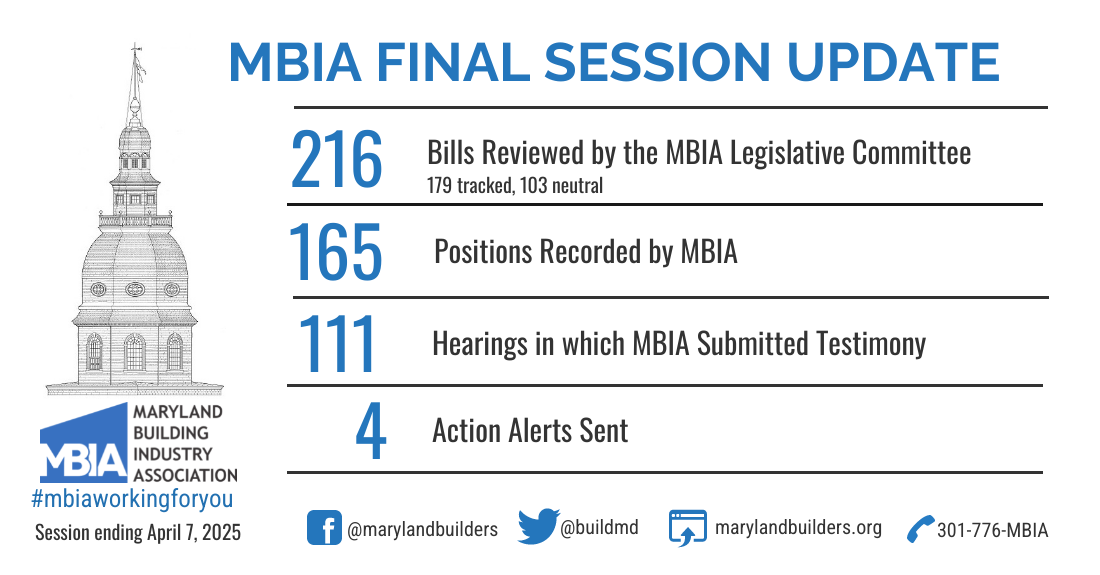
In 2025, the Maryland Building Industry Association reviewed 216 of the 3281 bills introduced by the Senate and the House.
MBIA took a position on 165 bills and submitted testimony on 111.
In 2025, the Maryland Building Industry Association reviewed 216 of the 3281 bills introduced by the Senate and the House.
MBIA took a position on 165 bills and submitted testimony on 111.
"We are very proud of the successes we achieved during the 2025 Legislative Session and the MBIA Government Affairs team will continue to work hard on behalf of the building industry to make it easier for you to do your job."
- Lori Graf, CEO, MBIA
The Maryland Building Industry continued to work hard representing you and other members of the Industry. During the 2025 Legislative Session, there were over 3000 bills introduced. MBIA reviewed over 200 of these bills. The subject matters ranged from land use, common ownership communities, contracts, construction and many more.
We are proud of the outcome of the 2025 session and are happy to report that we supported many pieces of legislation that will move housing forward in the State. We are even happier to report that there was no legislation passed that will negatively impact the industry.
While we do many things at MBIA, including education, networking and events, to name a few, advocacy is always one of our priorities. This is what helps you grow and sustain your business.
As always, please feel free to reach out to Lori Graf, CEO, MBIA if you have any questions.
MBIA Priority Legislation
Black - MBIA supported, bill did not pass
Green - MBIA supported, bill passed
Red - MBIA opposed, bill did not pass
Orange - MBIA opposed, bill passed
Budget
- Includes:
- $2 Billion in cuts, $1.6 Billion in taxes/fees
- 3% Data/ IT tax (quantum computing, cloud computing and cyber work are exempt)
- Surcharge on Capital Gains (for those making over $350,000)
- 2 new tax brackets for those making over $500,000 (6.25%) and $1 million (6.5%)
- Enables counties to raise piggy back tax from 3.2% to 3.3%
- $.20 per fee to view land records at the Maryland Archives
- What is NOT included:
- Combined reporting
- Broad based tax on services
Land Use/Housing
SB190/HB80- Land Use- Transit-Oriented Development- Alterations- establishes prohibitions and requirements with respect to local governments’ regulation of land use in relation to transit oriented development.
SB327/HB390- Affordable Housing Payment In lieu of Taxes Expansion Act- authorizes county governments to exempt real property used for rental housing from the county property tax if the property owner maintains at least 25% of the rental housing units as affordable units and enters in to agreement with the county. Must be maintained for 15 years (as introduced it was 50%). Effective dates June 1, 2025.
SB430/HB503- Land Use- Housing Development Act (formerly Housing for Jobs Act)- as introduced the bill created objective standards for denials of housing projects. It also created a builder’s remedy. As amended the bill creating an early vesting period as well as housing targets and a commission to evaluate housing supply.
SB814/HB698- Local Government- Development Impact Fees, Surcharges, and Excise Taxes- Reporting- the bill requires, by July 1, specified counties to report information regarding the collection of development Impact fees, surcharges, and excise taxes. The information is reported to Department of Planning and make it available on their county website. Effective Date 10/1/2025.
SB891/HB1466- Land Use and Real Property- Accessory Dwelling Units- Requirements and Prohibitions- requires the counties and municipalities to adopt a local law authorizing the development of accessory dwelling units on land with a single family detached unit as the primary dwelling unit. Effective date: October 1, 2025.
SB944/HB1193- Housing Development Permits- Local Reporting Requirements (Maryland Housing Data Transparency Act)- requires each jurisdiction with at least 150,000 residents to submit a quarterly report to the Department of Planning regarding various permitting data on residential housing. Reports start January 1, 2027. The Department of Planning must submit annual report to the Governor and General Assembly. Effective Date: July 1, 2025
HB38- School Construction and Housing- School Zones and Adequate Public Facilities- the bill requires local board of educations to submit a student residency and school zones report to the Department of Planning and the Interagency Commission on School Construction. Repeals the authorization of the IAC to make certain enrollment deductions and prohibits a county’s adequate public facilities ordinance from restricting housing developments for more than 4 years.
HB1444- Local Government- Moderate Income Housing Unit Requirements- Prohibition Against Fee-in-Lieu- prohibits a local government from authorizing payment of a fee-in-lieu of a MIHU requirement under local law.
Environment/Energy/Building Codes
SB256/HB49- Environment- Building Energy Performance Standards- Compliance and Reporting- as amended, the bill:
-
Strikes most of the bill (including EUI language and alternative compliance fees)
-
Grandfathers Montgomery County (so buildings in Montgomery County only need to comply with County), however it will not allow any other county to create their own BEPS program.
-
Creates additional exemptions (hospitals, life science, data centers, etc.)
-
Requires MDE to study the BEPs program and the costs (this is more detailed in the bill language)
-
$100 per building annual fee
SB290/HB362- Natural Resources- Roadside Tree Removal Permit Notification Act- requires an applicant for a roadside tree removal permit to provide a notice to all owners of property abutting and adjacent to the property subject to the tree removal and to governing body of any common ownership community.
SB436/HB489- Maryland Department of Labor Study on Building Code Requirements for Single-Staircase Buildings- requires the Department of Labor to study building code requirements for single-staircase buildings in the State and other states and analyze best practices. Report to the General Assembly by December 1, 2026.
SB804/HB973- Better Buildings Act of 2025- requires the Department of Labor to adopt, by October 1, 2025, and as part of the Maryland Building Performance Standards, energy conservation requirements, an electric and solar ready standard for new buildings, and requirement that new buildings and significant improvements meet all laundry, water, and space heating demands of the building without the use of fossil fuels.
SB807- Environment- Local Building Energy Performance Standards- Authorization authorizes counties to adopt local building energy performance standards that are at least as stringent as state standards.
SB978/HB1484- Environmental Permits- Requirements for Public Participation and Impact and Burden Analysis (Cumulative Harms to Environmental Restoration for Improving Shared Health – CHERISH Our Communities Act) applying public participation requirements to permits for projects that have been identified by MDE as having increased potential for adverse community environmental and public health impacts.
HB212- Maryland Building Performance Standards- Fossil Fuel Use and Electric-Ready Standards- requiring the Department of Labor to adopt, on or before January 1, 2026, and as part of the Maryland Building Performance Standards a requirement that new buildings meet all energy demands of the building without the use of fossil fuels and an electric-ready standard for certain buildings.
HB671- Environment- On-Site Sewage Disposal Systems- Climate Vulnerable Area requiring, by January 1, 2026, a county water and sewage plan to include a plan to minimize inundation risks to existing on-site sewage disposal systems and limit the installation of new on-site sewage disposal systems in climate vulnerable areas.
HB1496- Building Code- Construction and Significant Renovation of Housing Units- Electric Vehicle Parking Spaces requiring the construction of new multi family residential buildings to include a certain number of electric vehicle charging stations. It also required electric vehicle charging to be added with certain significant renovations.
Condo/HOA
SB63/HB292- Cooperative Housing Corporation, Condominiums, and Homeowners Association- Funding of Reserve Accounts and Preparations of Funding Plans makes various changes related to reserve studies including:
-
Extends time that COC’s have to complete initial reserve study
-
Allows for updated reserve studies
-
Creates financial hardship provision
-
Defines “funding plan”
SB866/HB306- Common Ownership Communities- Ombudsman Unit, Governing Document Database, and Local Commissions establishes the Common Ownership Community Ombudsman Unit in the Office of the Attorney General to receive and respond to complaints. It also requires common ownership communities to file documents with DHCD.
HB295- Real Property- Condominiums and Homeowners Associations- Governing Bodies and Annual Meetings requires that unit owners or lot owners have opportunity to comment during certain meetings. Requires developer to notify unit owners prior to being released from bonds.
Constructions/Trades
SB263/HB92- Heating, Ventilation, Air-Conditioning, and Refrigeration Contractors- License Restoration- extending from 90 days to 4 years the time period during which an individual who has held a heating, ventilation, air-conditioning, and refrigeration contractor license restoration after expiration. Effective date: October 1, 2025.
HB451- State and Private Constructions Contracts- Prompt Payment Requirements- requires a private construction contract to include a provision requiring the owner to pay the contractor within a certain period.
Real Property/Real Estate
SB441/HB606- Real Property- New Home Sales- Entry of Final Sale Price in Multiple Listing Service- requires a developer, builder, broker, or real estate agent to enter the final sale price of a new home into multiple listing service or similarly accessible database.
SB582/HB1428- Sale of Residential Property- Taxes and Offers to Purchase (End Hedge Fund Control of Maryland Homes Act of 2025) imposes measurers designed to limit the purchase of single-family residential real property by large real estate investment companies by 1) restricting the sale of single-family residences 2)increasing the State transfer tax rate to 15% on the sale of single-family residences to certain real estate enterprises and 3) establishes a 50% excise tax rate and $10,000 per unit penalty based on the excess ownership of single-family residences.
SB881/HB1370- Transportation- Regional Transportation Authorities (transfer tax) establishes regional transportation authorities. Creates non lapsing fund that is funded through various fees including surcharge on transfer tax.
HB23- Property Taxes- Authority of Counties to Establish a Subclass and Set a Special Rate for Commercial and Industrial Property authorizes local jurisdictions to establish a subclass of real property consisting of certain commercial and industrial property and set a special property tax rate for those properties.
HB339- Real Property- Residential Rental Apartments- Air-Conditioning Requirements requires landlords to provide air conditioning, from June 1 through September 30 each year. Landlords are to provide air conditioning in residential rental units 1) beginning June 1, 2025 for newly constructed units and 2) beginning October 1, 2025, for existing units and undergo renovation.
HB342- State Transfer Tax- Rates and Distribution of Revenue altering the State transfer tax rate and the distribution of State transfer tax revenue.
Landlord and Tenant
SB442/HB767- Real Property- Landlord and Tenant- Procedures for Failure to Pay Rent, Breach of Lease, and Tenant Holding over (Tenant Possessions Recovery Act) As introduced: bill required additional notice prior to eviction and required landlord to hold/store property for 10 days after eviction. As passed: counties have flexibility on notice provisions and landlords do not need to hold/store property, just provide notice.
SB514- Landlord and Tenant- Residential Leases- Prospective Tenant Criminal History Records Check restricts landlord’s use of a prospective tenant’s criminal history records.
SB609/HB817- Residential Leases- Use of Algorithmic Device by Landlord to Determine Rent- Prohibition prohibits a landlord from using certain “algorithmic devices” to determine the amount of rent to charge a residential tenant.
SB651/HB709- Landlord and Tenant- Residential Leases and Holdover Tenancies- Local Good Cause Eviction authorizes a county to enact local laws that prohibit a landlord from failing to renew a lease during the lease period or seeking to terminate a holdover tenancy without a “good cause”.
HB242- Discrimination in Housing- Consumer Credit History prohibiting the inclusion of consumer credit history in a reusable tenant screening report. Prohibiting discrimination in housing on the basis of consumer credit history.
General Business/Taxes
SB1045/HB1554- Sales and Use Tax- Taxable Business Services- Alterations created a broad tax on certain NAICS codes (services) of 2.5%
Local Bills
SB550/HB1189- Baltimore City- Property Tax- Authority to Establish a Subclass and Special Rate for Vacant Property Owned by Nonprofit Organizations. Authorizes Baltimore City to establish a subclass of real property that is owned by nonprofit organization and has been vacant for at least five consecutive years.
HB1178- Baltimore City- Property Taxes- Authority to Set Special Rates authorizes the City to set special property tax rates for any class or subclass of property. Sent to Summer Study.HB335- Baltimore County- Nuisance Actions – Community Association alters the definition of “community association” and “local code violation” in provision that authorize a community association in Baltimore County to see injunctive relief for nuisance abatement.
HB335- Baltimore County- Nuisance Actions – Community Association alters the definition of “community association” and “local code violation” in provision that authorize a community association in Baltimore County to see injunctive relief for nuisance abatement.
SB728/HB1284- Charles County- Governing Bodies of Common Ownership Communities- Member Training requires, in Charles County only, each member of a board of directors or officer of a council of unit owners to complete a training curriculum.
SB777- Howard County – Common Ownership Communities Funding of Reserve Accounts makes various changes, in Howard County only, to reserve funding requirements.
SB970- Howard County- Department of Planning and Zoning- Parking Space Requirements adds provisions to Public Local Laws of Howard County that requires Department of Planning and Zoning to consider whether infrastructure for pedestrians could offset the need for the construction of any parking spaces.
HB1167- Montgomery County- Municipal Authority to Regulate Structures authorizes a special taxing district in Montgomery County to impose additional or stricter building requirements (than State, regional or county requirements). As amended, only applies to buildings with four or fewer dwelling units and their accessory structures without regard to the zoning for the land where the building is located. Effective date: October 1, 2025.
HB1234- Montgomery Prohibited Restrictions- Accessory Dwelling Units allows that any restrictions on accessory dwelling units in Montgomery County are void.
HB1231- Montgomery County and Prince George’s County- Qualifying Municipal Corporation- Land Use authorizing certain municipalities (with population of more than 15,000) in Prince Georges County to exercise powers of the Prince George’s County Planning Board, the zoning hearing examiner or the District Council for Prince Georges County to make land use decisions.
SB832- Prince Georges County- District Council Zoning Laws- Override by Municipal Corporation authorizes a municipality in Prince George’s County to override a zoning law made by the district council if the zoning law affects land use within the jurisdiction of the municipality.
HB1266- Task force to Study Land Use Issues in Prince Georges County establishes a Task Force to Study Land Use Issues in Prince George’s County.
QUICK LINKS
Thank you to our
Platinum Stars Club Sponsors:


